Turnitin is the default academic integrity software for millions of educators globally, deeply embedded into Learning Management Systems like Canvas and Blackboard. But as the stakes around generative AI rise, faculty and students alike are asking: just how accurate is Turnitin AI detection? The gap between vendor marketing claims and real-world classroom performance has never been wider.
As we covered in our definitive guide to the best AI detectors for teachers, relying on a single piece of software to dictate academic discipline is a massive liability. Turnitin provides an incredibly convenient, zero-friction initial scan, but its underlying detection model is not infallible. In this deep dive, we look at the independent data, investigate why major universities have pushed back against the tool, and reveal what educators should use instead.
Key Takeaways
- Turnitin claims a false-positive rate of under 1%, but independent institutional testing reveals a much higher margin of error.
- Top-tier universities, including Vanderbilt and Washington State University, previously disabled the automated AI feature due to accuracy concerns.
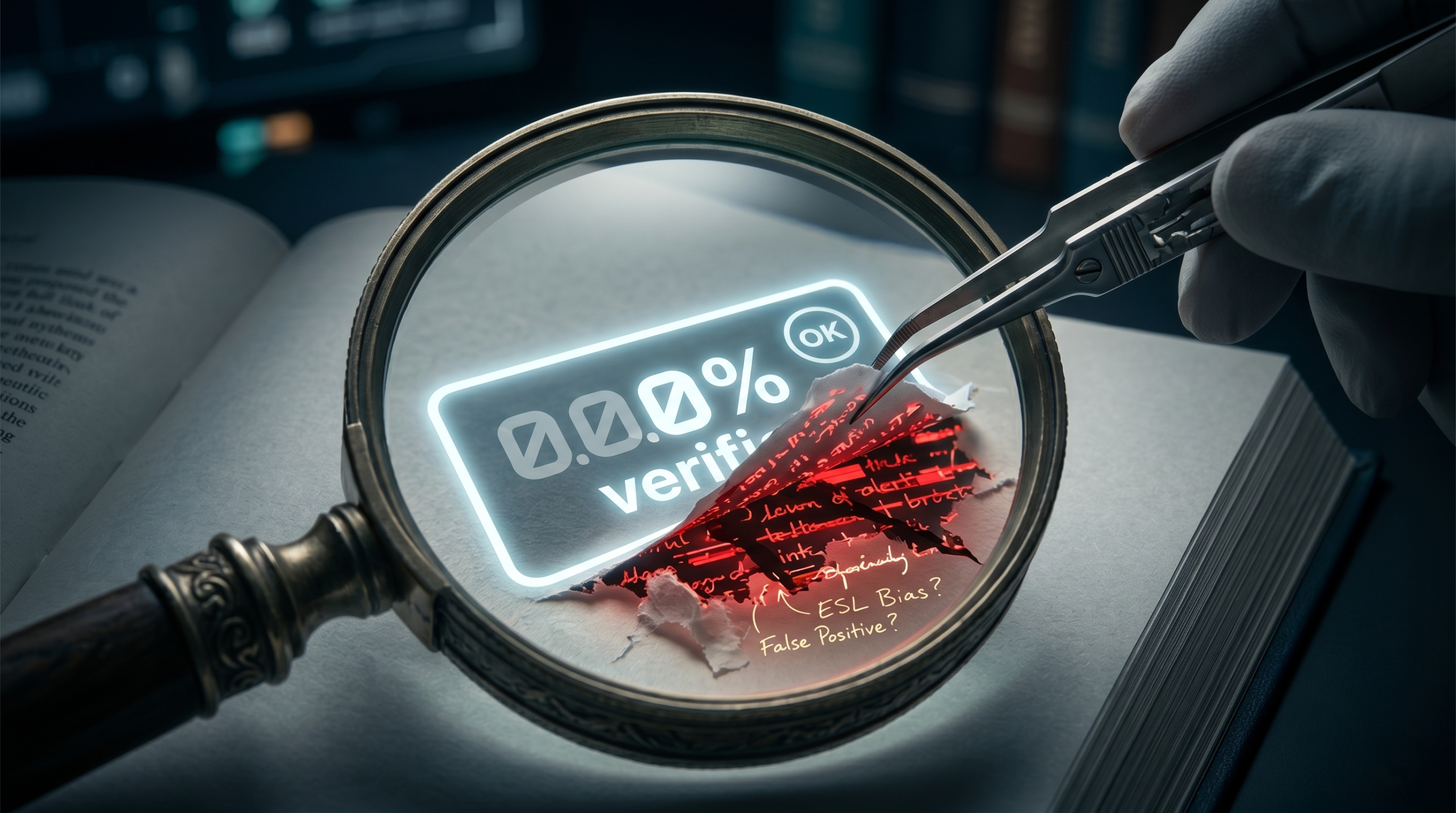
- Turnitin’s detection model struggles heavily with human-written essays produced by ESL students.
- Educators must supplement Turnitin’s percentage score with independent verification tools and strict process evidence.
The Official Turnitin AI Detection Accuracy Claims vs. Reality
When Turnitin launched its AI detection module, the company boldly claimed that its software could identify AI-generated text with 98% accuracy and maintained a heavily controlled false-positive rate of less than 1%.
On paper, those numbers are reassuring. In practice, the sheer volume of essays processed means that even a 1% failure rate results in tens of thousands of falsely accused students globally.
Tester’s Note:
To understand the broader context of detection tools, we analyze ongoing AI detector accuracy data. What our testing—and the testing of several independent university boards—shows is that Turnitin is highly effective at catching raw, unedited ChatGPT outputs. However, its accuracy plummets when evaluating nuanced human writing that happens to be highly structured.
The most alarming flaw in Turnitin’s accuracy is its disproportionate impact on non-native English speakers. Because AI models flag predictable syntax (low perplexity), the formulaic, standardized vocabulary often utilized by ESL students frequently triggers devastating false positives.
Why Major Universities Disabled Turnitin’s AI Feature
If Turnitin were perfectly accurate, it would be celebrated unconditionally. Instead, it has faced significant institutional backlash.
By early 2026, several prominent institutions recognized that the academic risk of trusting an automated black box was too high. Vanderbilt University and Washington State University made headlines when they explicitly disabled or severely restricted the use of Turnitin’s AI detection feature within their LMS environments.
False-Positive Warning (Institutional Risk):
University administrators cited the fact that Turnitin’s AI score could not be definitively proven in an appeal setting. When a tool flags a student, but the student possesses Google Docs version history proving they wrote the essay over several days, the software’s authority collapses.
To combat this, educators must adopt the essay workflow Turnitin doesn’t document: combining the initial LMS score with a manual review of document telemetry, early-semester writing baselines, and oral defenses.
Does Turnitin Detect Paraphrased AI Text?
A major weakness in broad institutional scanners is their response to adversarial manipulation. While Turnitin effectively catches a direct copy-paste from an AI chatbot, its accuracy drops significantly when a student uses a paraphrasing tool like QuillBot or an “AI humanizer” before submitting the text.
Aggressive paraphrasing disrupts the statistical predictability that the Turnitin model is searching for. While the company regularly updates its algorithms to combat these bypass methods, the cat-and-mouse game means that highly modified AI text often slips through as a false negative.
Good Turnitin Alternatives for Teachers
Because Turnitin requires an expensive institutional license, individual teachers often cannot access it outside of their school’s LMS. Furthermore, the accuracy concerns mean that even those with access need a reliable secondary tool to double-check high-probability flags.
We consistently recommend supplementing Turnitin with independent, high-accuracy alternatives that prioritize data privacy and transparency.
- Copyleaks: Known for having one of the lowest false-positive rates on the market, Copyleaks is an enterprise-grade alternative that offers strict FERPA compliance and deep LMS integration options. It is highly effective for institutional buyers seeking a fairer model.
- GPTZero: Designed specifically for educators, GPTZero provides a detailed, sentence-by-sentence breakdown rather than just an overall percentage score. Their generous free tier makes it the perfect secondary tool for a teacher wanting to verify a Turnitin flag.
- Pangram Labs: Emerging as a powerhouse for deep-level text analysis, Pangram focuses intensely on minimizing false accusations, making it an excellent resource for complex academic investigations.
Before you rely solely on your school’s mandated software, take control of your academic integrity process. Read our full Copyleaks review to see how modern independent alternatives provide a much safer, fairer safety net for your students.

Frequently Asked Questions
How accurate is Turnitin’s AI detection?
While Turnitin officially claims a high accuracy rate with less than a one percent false-positive margin, real-world academic testing reveals a different reality. Its accuracy heavily depends on the student’s writing style, and it struggles significantly with heavily paraphrased AI text and non-native English submissions.
What false positive rate does Turnitin claim?
Turnitin officially claims that its AI detection tool maintains a false positive rate of less than one percent. However, independent audits and institutional testing by universities have repeatedly challenged this figure, finding that the software flags human writing at a considerably higher and riskier frequency.
Why did Vanderbilt and WSU disable Turnitin AI?
Vanderbilt and WSU disabled Turnitin’s AI feature because internal reviews revealed an unacceptable risk of false positives. Administrators determined that the software’s automated flags could not be blindly trusted for disciplinary action, forcing a pivot back toward manual evidence gathering and traditional academic integrity investigations.
Is Turnitin’s AI score reliable?
Turnitin’s AI score is not reliable enough to be used as standalone proof of cheating. It represents a statistical probability, not a definitive fact. Educators must treat the score as an initial warning flag that requires further investigation and manual corroboration, such as document version history.
Does Turnitin detect paraphrased AI text?
Turnitin’s detection model struggles significantly with heavily paraphrased AI text. When students generate content with ChatGPT and then run it through advanced humanizer tools or aggressive paraphrasing software like QuillBot, the resulting text often bypasses Turnitin’s baseline detection algorithms, resulting in a false negative.
Is Turnitin better than GPTZero or Copyleaks?
Turnitin is deeply integrated into university systems, making it convenient. However, independent platforms like GPTZero and Copyleaks frequently outperform it in independent accuracy tests, particularly regarding lower false-positive rates and their ability to provide detailed sentence-level transparency metrics rather than just a blanket percentage.
Can Turnitin’s AI detection be wrong?
Yes, Turnitin’s AI detection can absolutely be wrong. The software routinely misinterprets highly structured, formulaic human writing as machine-generated. This false-positive flaw disproportionately impacts non-native English speakers who rely on predictable vocabulary patterns, leading to disastrous false accusations if the score is not manually verified.
Should institutions still use Turnitin AI detection?
Institutions should use Turnitin cautiously. Rather than disabling it completely, universities should redefine its role. It must be treated strictly as an educational indicator or an initial screening tool, paired with strict policies that forbid academic penalties based solely on the software’s automated probability score.
What are good Turnitin alternatives?
For educators seeking high-accuracy alternatives with lower false-positive rates, Copyleaks and Pangram Labs are currently the top institutional choices. For individual teachers needing an accessible, transparent baseline scan without enterprise licensing, GPTZero offers an exceptional free tier designed specifically for academic workflows.
Does Turnitin store and reuse student work?
Turnitin generally stores submitted student work in its proprietary database to cross-reference against future submissions for traditional plagiarism checks. However, under institutional licensing agreements and FERPA compliance, schools often configure settings that restrict Turnitin from reusing or selling specific student data for external AI training.