
Students often assume that bypassing an automated checker guarantees they have beaten the system. Conversely, cautious educators fear that relying solely on software will lead to disastrous false accusations. To understand how do professors detect AI writing safely, you have to look beyond the software dashboard. As we detailed in our comprehensive guide to the best AI detectors for teachers, the most effective academic integrity processes treat software scores as a starting point, not a final verdict.
In 2026, relying on a single AI percentage score is an academic liability. To build a case that holds up during a formal appeal, professors are returning to a mix of manual stylometry analysis, stringent process evidence gathering, and in-person verification. Here is the full, multi-layered method educators actually use to verify generative AI.
Key Takeaways
- Professors establish a “writing baseline” early in the semester to compare against future, high-stakes submissions.
- Process evidence, particularly Google Docs version history, is the strongest indicator of authentic human drafting.
- Manual signals, such as overly sanitized transitions and a lack of specific course context, often reveal AI use before a detector is even run.
- Software is used strictly as a corroborating signal, never as the sole evidence for an accusation.
Establishing a Student Writing Baseline
The foundation of how professors detect AI writing is establishing context. You cannot accurately determine if a student is writing artificially unless you know how they write naturally.
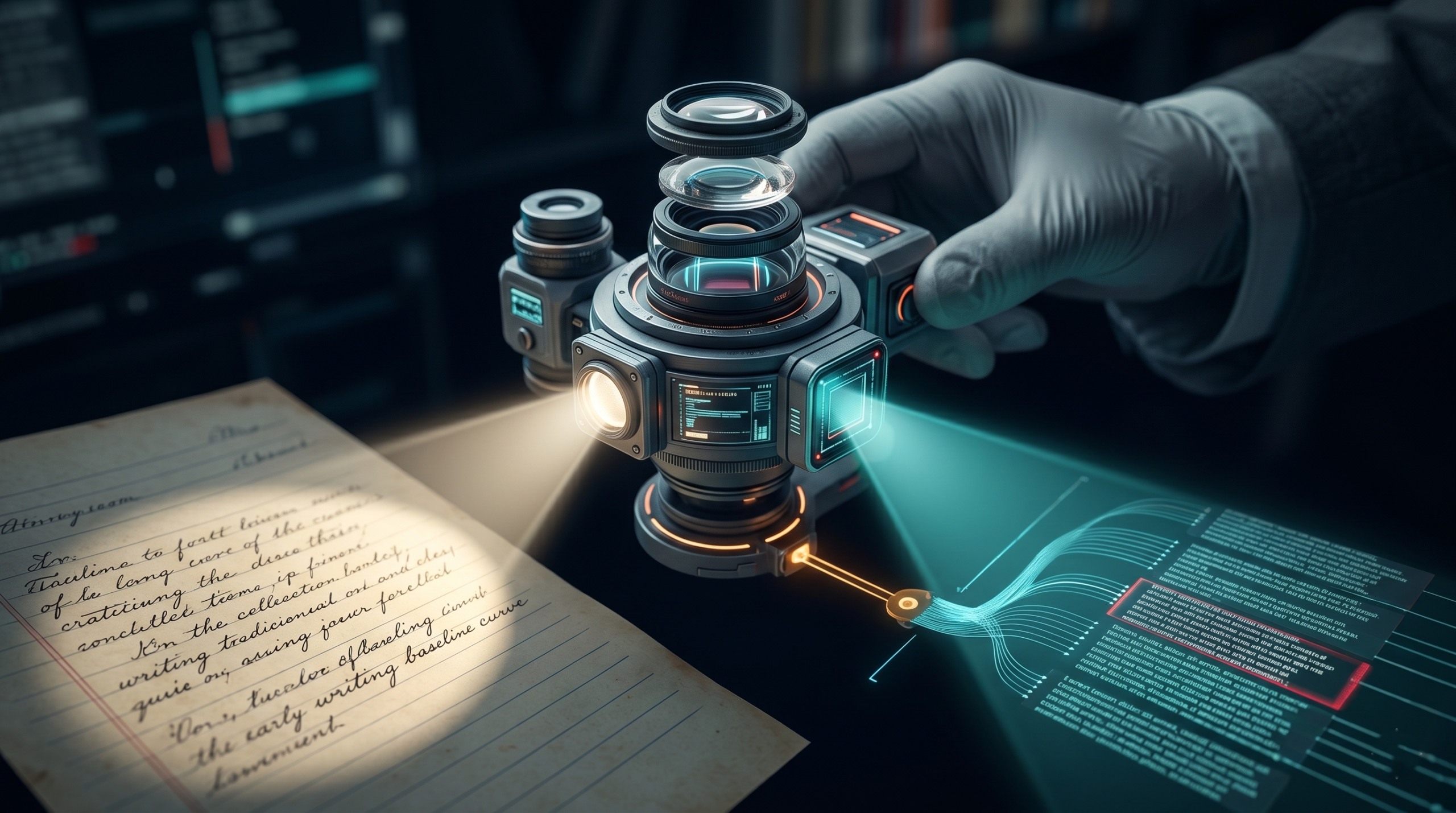
To achieve this, professors gather a writing baseline during the first week of class. This is usually an unannounced, handwritten essay or a locked-browser reflection. This initial sample serves as the ultimate stylometric anchor for the semester.
When a mid-term paper is submitted, the professor immediately compares its syntax, vocabulary depth, and sentence variation against that baseline. If a student who previously struggled with basic comma splices suddenly submits a perfectly structured, highly complex analysis, the professor’s manual detection radar is triggered before the document ever touches an AI checker.
Recognizing Manual Signs of AI-Written Work
Long before running a file through an automated tool to see how AI content detectors work, seasoned educators look for distinct, human-verifiable hallmarks of machine generation.
Stylometry and Predictable Syntax
Generative AI writes with incredibly low perplexity. It chooses the most statistically probable next word, resulting in a text that feels sanitized and rhythmically monotonous. Professors look for:
- Overuse of robotic transitional phrases (e.g., “In conclusion,” “It is important to note,” “Furthermore”).
- Perfect, yet highly generic, sentence structures lacking a distinct, personal voice.
- A “sandwich” paragraph structure where every point is neatly introduced, vaguely supported, and immediately summarized without true analytical depth.
AI Hallucinations and Lack of Class Context
AI models do not attend lectures. When students generate an essay, the AI often misses nuanced, class-specific discussions or, worse, invents academic sources (known as hallucinations). If an essay completely ignores the professor’s specific lecture framing in favor of broad, generalized Wikipedia-level knowledge, it is a massive manual red flag.
The Role of Process Evidence
The most defensible way to prove authorship is to analyze the creation process itself. If a student is flagged by an AI tool, and a professor suspects foul play, they move to collect undeniable process evidence.
Google Docs Version History
Document telemetry is difficult to fake. A student writing an authentic essay will have a document history filled with typing sessions, deleted paragraphs, formatting changes, and typos over several days.
If the version history shows that a 2,000-word essay was pasted into the document in a single keystroke, it serves as near-definitive proof of external generation, circumventing the need to debate the likelihood of AI detector false positives entirely.
The Oral Check
When the text and the version history remain ambiguous, professors conduct an oral defense. They will ask the student to define a complex word they used in the essay or explain how they arrived at their core thesis. A student who authored the work can easily discuss their cognitive process; a student who generated it will freeze.
Combining Manual Signals with AI Detection Tools
If you want to master the complete essay workflow Turnitin doesn’t document, it involves systematically layering these manual steps with targeted software analysis.
Tester’s Note:
In our before-and-after sample testing, an essay written entirely by an AI scored a 98% AI probability on its initial scan. However, when a human writer manually edited the document to inject personal anecdotes, specific lecture quotes, and organic varied sentence lengths, the AI score plummeted to below 20%. The software can be influenced, but a professor analyzing the lack of version history and the generic structural framing cannot.
Professors use enterprise and independent platforms—like Pangram Labs—purely for corroboration. If the manual signals suggest cheating, the lack of version history supports it, and a highly accurate AI tool flags it, the professor finally has a cohesive, defensible case that will survive an academic appeal.

Frequently Asked Questions
How do professors detect AI writing?
Professors detect AI writing by combining automated detection software with a thorough manual review of the student’s writing baseline, syntax, and document version history. Rather than relying purely on software percentages, they use these tools to corroborate their own academic observations.
Can professors tell if you used ChatGPT?
Yes, professors can often tell if you used ChatGPT. Beyond running text through detection tools, they look for distinct AI hallmarks: overly sanitized transitions, lack of personal voice, repetitive sentence structures, and an inability to cite specific, recent course materials accurately.
What manual signs reveal AI-written work?
Manual signs of AI-written work include a sudden, drastic improvement in a student’s vocabulary compared to previous assignments, the presence of AI hallucinations (invented facts), highly generic or repetitive transitional phrases, and a complete absence of nuanced, class-specific contextual analysis.
Do professors rely only on detectors?
No, experienced professors do not rely only on detectors. Because detection software can produce false positives, educators use these tools strictly as preliminary screening mechanisms. A high AI score simply triggers a deeper manual investigation into the student’s research and drafting process.
How does Google Docs version history help?
Google Docs version history is the most powerful tool for confirming human authorship. It allows professors to see exactly how a document was drafted over time. A genuine essay shows organic typing and revisions, whereas AI text appears as massive, instantaneous blocks.
Can professors detect AI in code or math work?
Detecting AI in code or math work is more challenging because these subjects naturally have lower perplexity and rigid structures. Professors often rely on oral defenses, asking students to explain their logic line-by-line, rather than using standard text-based detection software.
What is a writing baseline and how is it used?
A writing baseline is an early-semester sample of a student’s authentic work, often gathered through in-class handwritten assignments. Professors use this baseline to evaluate future submissions. If a new essay suddenly features wildly different stylometry or advanced syntax, it raises a flag.
Do oral defenses catch AI use?
Yes, oral defenses are highly effective at catching AI use. When a professor asks a student to explain specific arguments, sources, or complex vocabulary used in an essay, a student who relied heavily on generative AI will typically struggle to articulate their thoughts.
How reliable are these methods combined?
When combined, these multi-layered methods are highly reliable. While a standalone AI detector score is vulnerable to false positives and appeals, coupling that score with a lack of version history and a failed oral defense creates a robust, defensible case.
What detection methods hold up in an appeal?
In an academic appeal, clear process evidence holds up best. Boards look for documented deviations from the student’s writing baseline, a verified absence of document editing history, and the professor’s notes from a face-to-face oral review, rather than just a software percentage.