
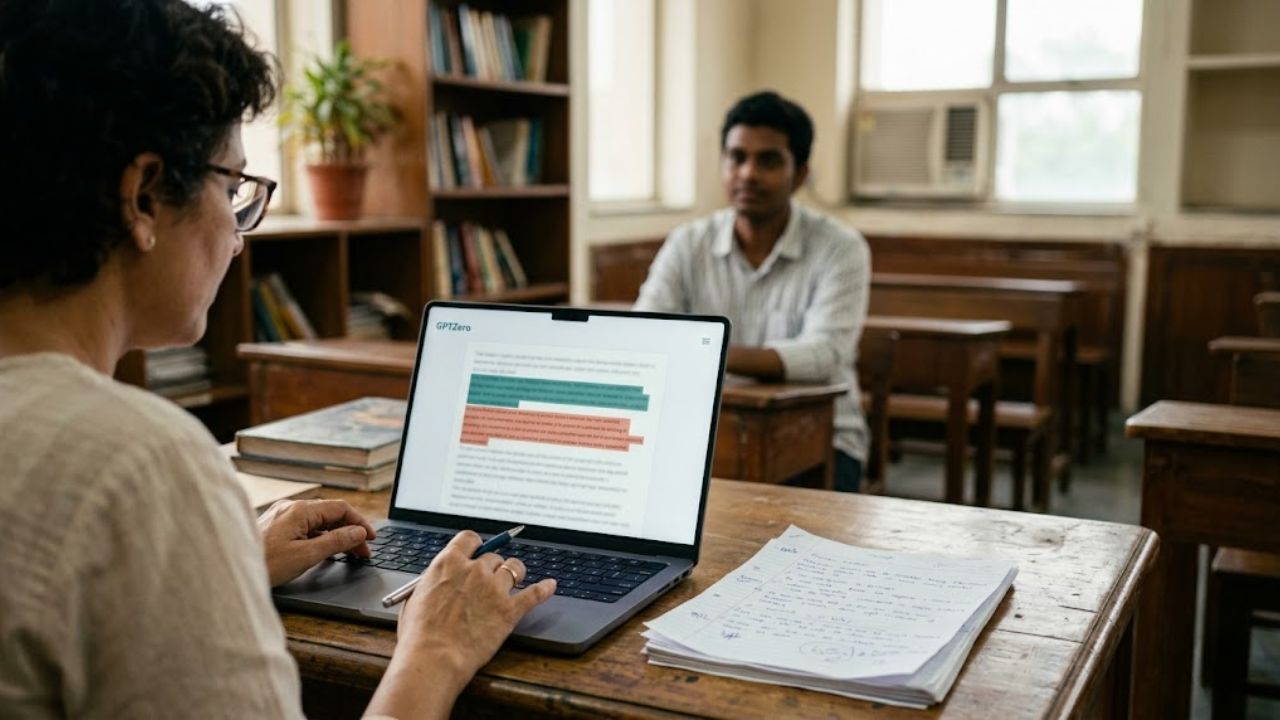
Three days ago, the Washington Post ran an editorial calling on schools to ban AI detectors. Two weeks ago, NPR reported on a high-school student whose grade was docked based on a detector score despite her insistence she wrote the essay herself. Earlier this year, Vanderbilt and Curtin joined a growing list of universities that have publicly disabled AI detection tools in their learning management systems.
If you are a teacher trying to figure out which AI detector to use in your classroom, you have probably noticed something is wrong with this picture. Vendor websites promise 99% accuracy. Researchers publish studies finding false positive rates of 10% to 30%. Students post on Reddit about being wrongly accused. Universities quietly turn the tools off.
All of this is happening at the same time, and somewhere in the middle sits a teacher who just wants to know if a student wrote their own essay.
I work as an AI trainer and consultant, which means I spend a lot of time helping teachers, administrators, and training departments think through exactly this problem. This guide is not a list of the five shiniest detectors ranked by affiliate commission. It is my honest read on which tools are fit for classroom use in 2026, which are not, and how to actually use them without creating the kinds of situations that end up in the news.
The short answer
If you need the single fastest answer, here it is.
For individual teachers who want a free, reliable tool, GPTZero is the safest starting point in 2026. It has one of the lowest false positive rates among widely available tools, it offers a free tier generous enough for regular classroom use, and it provides sentence-level breakdowns that make it easier to have fair conversations with students.
For universities and schools that already use Turnitin, the integrated AI detector is defensible but needs to be used with caution. Its false positive rate is genuinely low on clean native English writing, but its institutional adoption has led to some of the worst real-world failures we have on record.
For institutions that prioritize low false positives above everything else, Pangram Labs has emerged in 2026 as the research-backed option with independent verification of a very low false positive rate. It costs more and is less well known, but it is the tool that flags fewer innocent students.
No detector on the market is accurate enough in 2026 to serve as the sole basis for an accusation of academic misconduct. If you remember only one thing from this guide, remember that.
The data that should shape any choice
Before picking a tool, it is worth understanding what the current research actually shows, because the marketing claims and the independent research are very far apart.
On raw, unedited AI output from major models, the best detectors catch 90% to 96% of samples. This is the number detector companies put on their homepages, and it is genuinely true in controlled conditions.
On lightly edited AI content, which is how most students actually use AI in 2026, accuracy falls to 55% to 75%. Most students who use ChatGPT do not paste raw output into their submissions. They edit, rearrange, add their own sentences, and polish. Detector accuracy drops accordingly.
On humanized AI content run through a bypass tool, no major detector consistently identifies the content after three passes. GPTZero’s detection rate on humanized text fell to around 18% in early 2026 testing.
On short submissions under 300 words, detector accuracy collapses. Most vendors quietly acknowledge this in their documentation but continue to return confident-looking percentages anyway.
The false positive numbers are the part that should worry any teacher most. A 2026 follow-up to the original Stanford Liang study found a mean false positive rate of 61.3% for TOEFL essays written by Chinese students, compared with 5.1% for essays from US students run through the same tools. That is not a minor statistical wobble. That is a pattern that will generate wrongful accusations at scale if detectors are used as evidence.
Common Sense Media has reported that Black students are more likely to be accused of AI plagiarism by their teachers, and independent research has documented higher false positive rates for neurodivergent writers. The students most likely to be wrongly accused are, disproportionately, the students with the fewest resources to defend themselves.
This is the context any teacher needs to hold in mind when choosing a tool.
How I evaluate detectors for classroom use
When I recommend tools to schools and training departments, I weigh five things specifically, in this order of importance for education.
Low false positive rate comes first. In a classroom, the cost of accusing an innocent student is massively higher than the cost of missing an actual case of AI use. A student wrongly accused carries lasting damage. A student who got away with a ChatGPT essay one time did not, in the grand scheme of things, cause an emergency.
Sentence-level transparency comes second. A whole-document percentage tells a teacher nothing actionable. A tool that highlights specific sentences with confidence scores lets you have a real conversation with the student about what is happening in which paragraph.
Reasonable pricing and accessibility come third. Many teachers are paying out of pocket or working from an institutional license. A tool that is technically slightly more accurate but costs $30 a month per teacher is worse for most classrooms than a free tool that scores 5% lower on some benchmark.
Evidence of testing on diverse writers comes fourth. Any tool that has not been tested on non-native English speakers, neurodivergent writers, and students writing to rigid academic rubrics is a risk to the specific students you probably have in your class.
Institutional fit comes last. If your school already uses Turnitin, the friction of adopting a parallel tool outside that workflow is real, and sometimes the right answer is the one already installed.
Notice that vendor-reported detection accuracy is not on this list. The reason is that on the kind of edited, realistic student work teachers actually face, the advertised accuracy numbers are largely fiction. What matters is whether the tool fails in predictable, fair ways.
The tools, ranked for classroom use
Here is how the major options stack up for teachers in April 2026, based on independent research and real-world classroom use.
GPTZero
Best for individual teachers and small schools who need a free, reliable tool they can use daily.
Independent false positive rate is typically under 1% on native English writing, rising to 9% to 18% on certain writer backgrounds. Detection rate on unedited AI ranges from 62% to 88% in independent tests, which is lower than its own marketing claims but respectable in practice.
What it does well. GPTZero was purpose-built for teachers, which shows in the interface and the reporting. The sentence-level highlighting is clear. The free tier of 10,000 words per month is generous enough for regular class use. The tool has been honest in its public communications about the limits of AI detection, which is rare in this space.
Where it struggles. GPTZero is highly vulnerable to paraphrasing tools like QuillBot and to humanizer products. A student who runs ChatGPT output through a humanizer will usually pass GPTZero’s scan. Its accuracy on Claude and Gemini output is also lower than its accuracy on GPT-family models.
When to use it. Use it as a first-pass screening tool on full-length essays, with sentence-level breakdown enabled. Do not use it on submissions under 300 words. Do not use it as sole evidence in a disciplinary process.
Turnitin (institutional)
Best for universities and schools already paying for Turnitin, where the AI detector is bundled into the existing plagiarism workflow.
Turnitin’s reported false positive rate is around 1% on documents over 300 words, which is among the lowest in the industry. Its detection sensitivity is moderate rather than aggressive, meaning it misses roughly 15% of AI text deliberately, in exchange for fewer false accusations. The 2026 study in the International Journal for Educational Integrity found Turnitin performed acceptably but was outperformed by Originality.ai on several metrics.
What it does well. Turnitin’s institutional integration is genuine. Teachers already comfortable with Similarity Reports will find the AI detection feature familiar. The conservative calibration is the right trade-off for education.
Where it struggles. Turnitin’s real-world false positive rate in the field has been consistently higher than the controlled 1% figure. Several universities have disabled the tool after observing their own higher rates in practice. The University of Pittsburgh, the University of Minnesota, Montclair State, Vanderbilt, and Curtin have all either disabled Turnitin’s AI detector or declined to support its use. A Washington Post study produced a 50% false positive rate on a specific content type, which Turnitin has disputed but not fully explained.
When to use it. Use it if your institution provides it and your department has clear, fair policies around how the score is interpreted. Do not treat it as a standalone verdict, even at 1% false positive rate, because that one in a hundred student is a real student whose life your decision will affect.
Pangram Labs
Best for institutions that want the lowest available false positive rate backed by independent research.
Pangram has been the most interesting entrant in 2026. Its technology has been independently evaluated by university researchers, with studies demonstrating approximately a 1 in 10,000 false positive rate. That is an order of magnitude lower than most competitors. Detection accuracy on unedited AI is strong, in the 94% to 96% range.
What it does well. Pangram prioritizes accuracy over aggressive labelling, which is the right philosophy for education. Research-backed claims rather than internal marketing claims. Good LMS integrations. Sentence-level detection with clear highlighting.
Where it struggles. Pangram is less well known than GPTZero or Turnitin, which means less community support and fewer colleagues to compare notes with. Pricing is higher than GPTZero and it is not bundled into any major existing institutional platform. Adoption curve is steeper.
When to use it. Use it if you are selecting a detector at the institutional level and false positive risk is your primary concern, or if you have been personally burned by false positives from another tool.
Copyleaks
Best for multilingual classrooms or international school settings.
Copyleaks consistently scores well in independent testing, with detection accuracy comparable to Originality.ai and a false positive rate of 1% to 5% depending on the study. Its multilingual support is genuinely strong, covering many languages where other detectors struggle.
What it does well. Multilingual detection that actually works. Good enterprise features for schools. Lower false positive rate than most tools in its price range.
Where it struggles. Interface is less teacher-friendly than GPTZero’s. Pricing is mid-tier and usually requires a paid plan for anything beyond token testing.
When to use it. Use it if you teach in a multilingual setting or serve students writing in languages other than English.
Originality.ai
Best for publishers and content teams, not ideal for classrooms.
I list Originality.ai here because teachers occasionally ask about it, but I need to be direct. Originality.ai is built for publishers and SEO teams, not for educators. Its detection model is intentionally aggressive, which is the right call for a publisher trying to catch every piece of AI content in a freelancer submission pile, and the wrong call for a teacher who needs to avoid wrongly flagging an international student.
Independent testing has placed Originality.ai’s false positive rate anywhere from 2% in its own commissioned study to 14% to 28% in some third-party tests. It leads on detection rate against humanizer-processed content, but the cost of that aggression is more wrongful flags.
When to use it. Only use it in education if you are running a secondary check on something another tool has already flagged, not as your primary classroom tool.
Tools I would advise teachers to avoid
A few widely marketed tools are popular among teachers but should not be used as primary classroom detectors in 2026.
ZeroGPT has independent false positive rates measured between 14% and 33% depending on content type. That means more than one in seven human-written essays can be wrongly flagged. Regardless of how attractive the free tier is, this is not safe for academic decisions.
Sapling scored a 28% false positive rate in the Supwriter benchmark, which is the worst performance among major commercial tools. More than one in four human writers would be wrongly flagged.
Free browser-extension detectors and single-page web tools from unknown vendors. Many of these are wrappers around older models with no documented methodology. If a tool does not publish its false positive rate and testing methodology, assume the worst.
How to actually use an AI detector without causing harm
This is the part most “best of” lists skip, and it matters more than the ranking.
Run every flagged submission through at least two different detectors before drawing any conclusion. Agreement between tools is more reliable than any single score. If GPTZero, Turnitin, and Pangram all flag the same passage, that is meaningful signal. If only one tool flags and the others clear, the flag is probably a false positive.
Look at sentence-level highlighting, not the overall percentage. A 70% document score with the flagged sentences clustered in a single paragraph tells a very different story than 70% with flagged sentences scattered randomly throughout. The first suggests a specific part was pasted in. The second suggests the detector is confused.
Consider the student’s writing context. Is this a non-native English speaker? A student known to write in a highly structured, formulaic style? A neurodivergent student whose writing patterns are unusual? Students writing to a rigid rubric? All of these push scores up for reasons that have nothing to do with AI.
Talk to the student before taking action. Ask them to explain their draft. Ask what sources they used and how their thinking developed. Ask them to talk you through a specific paragraph. This approach is recommended by Turnitin’s own guidance, by multiple university teaching centres, and by every thoughtful educator I have worked with. A detector score is a prompt for a conversation, not a verdict.
Keep records. If you do find evidence of AI misuse, the detector score is one piece of a case. Notes from the conversation, comparison against the student’s prior work, patterns in the draft, and your professional judgment are all part of the evidence. No responsible institution should ever penalize a student on a detector score alone.
Have a written departmental policy. One of the biggest sources of unfair outcomes is inconsistent policy. When one teacher treats 70% AI as proof and another treats 95% AI as requiring a conversation, students suffer. Departments should write down what scores mean, what actions follow, and what rights students have.
A word to schools and administrators
If you are the person deciding whether your institution should adopt AI detection tools, the picture has shifted in 2026.
Several major universities have publicly walked away from these tools. Vanderbilt University and Curtin University have disabled Turnitin’s AI detection entirely. The University of Minnesota’s teaching support center explicitly does not recommend or centrally support any AI detection tool. Montclair State made the same call. The University of Pittsburgh’s Teaching Center declined to endorse Turnitin’s AI tool in its 2026 guidance. Two lawsuits, one at Yale and one at the University of Michigan, have involved students penalized based partly on detector scores.
This is not an argument that detectors have no place anywhere in education. It is an argument that institutional adoption without clear policy, careful training, and thoughtful integration is creating preventable harm.
If you are considering adopting these tools at institutional scale, the questions to answer first are:
Who will interpret the scores, and what training will they receive?
What is the appeal process for a flagged student?
What happens when the detector is wrong, and how do you measure how often that is?
Are there student populations disproportionately at risk, and how are you protecting them?
What is the specific value your institution gains, measured against the false positive cost?
Institutions that cannot answer these clearly should consider whether they are ready to deploy detection at all. Several of the universities that have walked away from these tools did so not because the technology is bad, but because they could not answer those questions.
The bigger picture
Here is the honest reality. AI detection is a useful input for teachers, and it is not going to become reliable enough in 2026 or 2027 to be the sole basis for academic decisions. The cat-and-mouse game between AI writers and AI detectors is not slowing down, and the detectors are currently losing ground against humanizer tools and against newer models like GPT-5-mini.
The educators who handle this well will treat detector scores as conversation starters. They will pair detection with assignment redesign, process-based assessment, in-class writing, oral defence of key papers, and other methods that make thinking visible rather than relying on a probability score from a tool that gets it wrong a measurable percentage of the time.
If you remember one principle from this whole guide, remember this. A detector never accuses a student. A teacher does. The tool is a signal. The judgment is still yours, and it always will be.
For the fuller picture on how these tools work under the hood, see our pillar guide on how AI detectors actually work. For the deeper data on why independent accuracy is often so far from vendor claims, see our data-driven accuracy analysis. If you or a student you know has been wrongly accused, our guide on what to do if you are falsely accused of using AI is being published next.
Frequently Asked Questions
What is the best AI detector for teachers in 2026?
GPTZero is the best free option for individual teachers, with a low false positive rate and a teacher-friendly interface. Turnitin is the most practical choice for universities already paying for it, though with caution. Pangram Labs has the lowest independently verified false positive rate and is the safest choice for institutions where false positives are the primary concern.
Are AI detectors accurate enough for classroom use?
They are accurate enough to be useful as a first-pass signal but not accurate enough to serve as the sole evidence for an accusation of misconduct. On unedited AI content, the best detectors catch 90% to 96% of samples. On the edited, realistic work students actually submit, accuracy falls to 55% to 75%. False positive rates vary widely between tools and are significantly higher for non-native English speakers and neurodivergent writers.
Why do universities like Vanderbilt and Curtin disable Turnitin’s AI detector?
Both institutions cited real-world false positive rates higher than the vendor’s controlled-condition claim, along with concerns about the lack of methodological transparency and the disproportionate impact on specific student populations. Several other universities including Montclair State, Pittsburgh, and Minnesota have made similar decisions or declined to endorse the tools.
Is GPTZero biased against non-native English speakers?
All major AI detectors show elevated false positive rates for non-native English speakers. The 2026 follow-up to the Stanford Liang study found a mean false positive rate of 61.3% for TOEFL essays written by Chinese students compared with 5.1% for US students. GPTZero has lower overall false positives than many competitors but is not immune to this pattern. Teachers with multilingual classrooms should be especially cautious.
Can students bypass AI detectors?
Yes, with increasing ease. Tools called humanizers are designed to rewrite AI output so it passes detection, and they are currently winning the arms race. After a few passes through a quality humanizer, most detectors fail to identify AI content. Students who are motivated to cheat and know about these tools will usually succeed at bypassing detection. Assignment redesign is a more reliable defence than tool-based detection.
Should I penalize a student based on an AI detector score?
Not on the score alone. A detector score is a prompt for a conversation, not evidence of misconduct. Best practice is to run the submission through a second detector, look at sentence-level breakdown, consider the student’s writing context, and have a direct conversation with the student before taking any action. Most institutions that have handled this badly did so by treating a score as proof.
Have a tool you want me to cover, a classroom experience you want to share, or a policy question you are working through at your institution?
Email me – sanjay@agilewow.com. I read every message and update this guide when the evidence shifts.
About the author: Sanjay Saini has 30+ years of experience in the IT industry and works as an AI trainer and consultant, helping businesses and institutions adopt AI responsibly.