
If you are reading this, something has probably already happened. A teacher flagged your essay. A client questioned your article. An HR team asked about your cover letter. Someone, somewhere, ran your writing through an AI detector and the tool told them you cheated.
You did not cheat. You wrote the work yourself.
Take a breath. You are not the first person this has happened to, and you are not the last. In 2023 alone, a Guardian investigation found nearly 7,000 confirmed cases of students caught using AI tools, but the rise in actual AI use has been matched by a quiet, less-covered rise in false accusations. Independent testing now places false positive rates for major AI detectors between 1% and nearly 30%. For non-native English speakers, one 2026 follow-up study found false positive rates of 61.3% on certain essay types. That means thousands of students, writers, and professionals are being wrongly accused every year, and the tools making those accusations are nowhere near as accurate as their marketing claims.
This guide is not legal advice. I am an AI trainer and consultant, not an attorney, and I say clearly at the end of this piece when you need one. But I work with organizations every day that deploy these tools, and I see both sides of this problem. I know what good defenses look like, what bad ones look like, and what evidence actually changes minds when an accusation is being reviewed.
Here is what to do, step by step, if you have been falsely accused of using AI.
Before anything else: stay calm and do not admit fault
The first few hours after an accusation are when most people make their worst mistakes. You feel panicked. You feel angry. You feel the urge to either apologize profusely or fire off a defensive email at midnight. Resist both.
Do not reply immediately. A delay of a few hours or overnight will not hurt your case. A rushed emotional reply often will.
Do not admit to anything you did not do, even to make the conversation easier. Some accused students, faced with an angry teacher and a detector score, have said things like “maybe I used AI without realizing it” just to de-escalate. Comments like this can be treated as admissions and used against you later in a formal process.
Do not accept a penalty in the moment. If your teacher offers a reduced grade “if you just admit it and we can move on,” that offer is almost never in your interest. Once you accept, the case is effectively closed with you marked as responsible.
Do not delete anything. Your drafts, your search history, your Google Docs version log, any notes or recordings. Everything on your computer or in your cloud accounts from around the time you wrote the piece is potential evidence. Do not clean up your desktop, do not archive old folders, and do not empty your trash.
Once you have given yourself a few hours to settle, move on to the next step.
Ask for the specific accusation in writing
Before you defend yourself, you need to know what exactly you are defending against. Reply to whoever raised the issue with a calm, professional request along these lines.
An email that works well usually covers four things. First, acknowledge the message and confirm you take it seriously. Second, ask for the specific concern to be stated in writing, including which tool was used, what score it returned, and whether the whole submission or only sections were flagged. Third, ask what the next steps in the process will be. Fourth, ask about any applicable policy documents, such as the syllabus, the student handbook, or a company handbook.
Here is a sample you can adapt:
Dear Professor [Name],
Thank you for reaching out. I take academic integrity very seriously and want to address your concern fully. To make sure I understand what I am responding to, could I please ask for the following in writing: which AI detection tool was used, what score it returned, whether the whole submission or only specific sections were flagged, and what the next steps in our institution’s review process are. I would also appreciate a copy of any relevant policy documents so I can review them before our next conversation.
I wrote the submission in question myself and am confident I can provide evidence to that effect. I look forward to resolving this fairly.
Best regards, [Your name]
Written requests like this accomplish three things. They create a record. They force the accuser to be specific. They signal you are calm, cooperative, and prepared.
Gather your evidence immediately
While you wait for a written response, start pulling together the evidence that proves you wrote the work yourself. The sooner you do this, the stronger your case. Some kinds of evidence degrade or disappear with time.
Here is what to look for, in rough order of how compelling it tends to be.
Version history and document timestamps
This is your single strongest piece of evidence. If you wrote the piece in Google Docs, Microsoft Word online, Notion, or any modern word processor, the software automatically tracks every edit.
In Google Docs, open the document, go to File, then Version history, then See version history. You will see a timeline of every change you made, with timestamps. A document you wrote yourself will show hundreds or thousands of small edits over hours. A document that was pasted in from ChatGPT will show a single large edit at one moment in time. This difference is visually obvious and almost impossible to fake after the fact.
In Microsoft Word online, go to File, then Info, then Version History. The same kind of timeline is available.
In Notion, page history is accessible from the three-dot menu at the top of any page.
Download or screenshot this version history as soon as you can. If your institution later deletes your access to shared documents as part of an investigation, you will want a copy you already have.
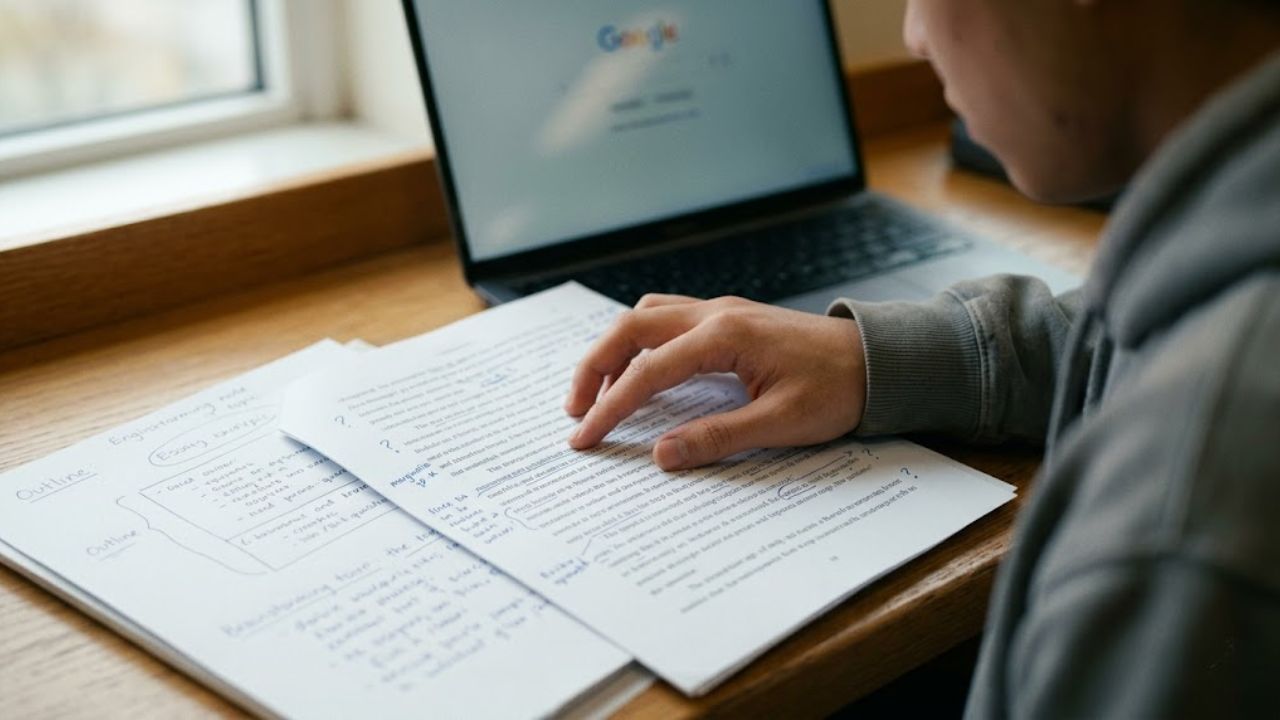
Drafts, outlines, and research notes
Anything you wrote on the way to the final piece strengthens your case. This includes:
Handwritten notes, even if they are messy. Photograph them and save the images.
Outlines or brainstorming documents you wrote before drafting the piece.
Earlier drafts, whether saved as separate files or accessible through version history.
Emails or chat messages where you discussed the piece with friends, classmates, or colleagues before submitting it.
Research you did for the piece, including bookmarks, notes on specific sources, printed articles with marginalia, and library access logs.
Browser history from the relevant period, showing research sessions on the topic.
The fact that you did research a detector would have no way to know about is powerful evidence of authorship.
Your writing style, documented over time
If you have a portfolio of prior writing, either shared publicly or saved privately, it can be used to demonstrate your style. AI detection tools do not personalize to individual writers. They cannot tell that your characteristic sentence openings, your favorite transition phrases, or your use of certain punctuation are patterns you have maintained across many pieces of work.
Gather three to five samples of your prior writing from before the accusation. If these predate the wide availability of ChatGPT, even better. Being able to say “here is work I wrote in 2021 that sounds exactly like the piece you are questioning” is a compelling argument.
Screen recordings or live writing
If you have the option going forward, consider using a tool like Grammarly’s Authorship feature, GPTZero’s Writing Report, or a screen recording app. These tools record your writing process as it happens and produce a report or video showing the work being composed.
This is preventive evidence rather than retrospective, so it only helps if you set it up before being accused. But for anyone who has been accused once, this kind of proactive measure is worth considering for all future work in contexts where accusations are likely.
Oral knowledge of your topic
This one is underused, but it can be decisive. If you genuinely wrote the piece, you know the material. You can explain why you structured it the way you did. You can talk about the sources you cited. You can discuss the ideas in your own words and relate them to other things you have read.
Offer, proactively, to have an oral discussion with your accuser about the content. Say something like “I would be happy to walk through any section of the piece in a conversation and explain the reasoning behind it.” This offer is exactly the test a thoughtful teacher or editor should want to run before penalizing you. Many will back down when it is offered, because they realize their accusation was based only on a number from a detector.
Understand the weaknesses in the accusation
Once you have your evidence, you need to understand the weaknesses in what was used to accuse you. The accusation is almost certainly based on an AI detector score. Those scores are much weaker evidence than most non-technical people realize.
Here are the facts you should know.
No AI detector is close to 100% accurate. Independent testing places even the best commercial tools at 55% to 80% real-world accuracy on realistic content. Vendor marketing figures of 99% are measured on clean AI output under laboratory conditions, not the kinds of mixed content people actually produce.
False positive rates vary wildly. GPTZero has typically tested between 1% and 18% false positives depending on the study. Sapling has been measured at 28%. ZeroGPT has been measured as high as 33% in certain tests. These are not edge cases. They are the published results of independent academic and commercial research.
Non-native English speakers are disproportionately flagged. The 2023 Stanford study by Liang and colleagues found AI detectors misclassified over 61% of essays written by non-native English speakers. A 2026 follow-up found a mean false positive rate of 61.3% for TOEFL essays from Chinese students compared to 5.1% for US students. If English is not your first language, this is directly relevant to your defense.
Highly structured writing is also over-flagged. Students writing to rigid academic rubrics, technical writers producing standards-compliant prose, and neurodivergent writers with organized, repetitive patterns all tend to be flagged at higher rates, even when they wrote the work themselves.
Major universities have publicly disabled these tools. Vanderbilt University, Curtin University, the University of Minnesota, Montclair State, and the University of Pittsburgh have all either turned off AI detection in their systems or declined to endorse its use. If your institution’s own peer institutions think these tools are too unreliable to use, that is a powerful argument for your case.
Turnitin itself acknowledges false positives. Turnitin has publicly stated that its tool can be wrong and should not be used as sole proof of misconduct. If your accusation is based on Turnitin, you can cite the company’s own statements.
Case studies of wrongful accusations exist. A professor at Johns Hopkins cleared a student whose essay had been 90% flagged by Turnitin after reviewing her drafts. A UK university accused a student named Albert of cheating after his use of common academic phrases like “in conclusion” triggered a detector, and the accusation was eventually dropped. Kelsey Ostovitz, a US high school student, was wrongly flagged and had her grade docked despite insisting she had written the essay herself. These cases have been covered by NPR, the Guardian, the Washington Post, and other reputable outlets.
Prepare your written response
With evidence in hand and the weaknesses of the accusation understood, you are ready to prepare a formal written response. This is the document that will go into the file if your case escalates, so it needs to be carefully written.
A strong response typically has five parts.
Opening: acknowledge and deny
Start by acknowledging the seriousness of the accusation and stating clearly that you deny it. Something like:
I take the concern about academic integrity very seriously and want to address it fully. I did not use AI to write this submission. I wrote it myself, and I am prepared to provide detailed evidence to that effect.
Avoid being defensive or emotional. A factual, composed opening sets the tone for the rest.
Evidence: present what you have
Lay out your evidence in order of strength. Start with version history. Move to drafts and notes. Then prior writing samples. Then your offer of oral discussion.
For each piece of evidence, briefly explain what it shows and why it matters. For example:
I wrote this piece in Google Docs over approximately six hours across three sittings. The version history attached shows 427 distinct edit events, including an initial outline at 2:14 PM on March 3, substantial revisions between March 3 and March 5, and a final editing pass on the morning of March 6. A document pasted from an AI tool would show a single large edit event, not the progressive composition visible in this history.
Context: explain any factors the detector missed
If any of the known detector weaknesses apply to you, mention them briefly. If English is not your first language, say so. If you have a documented learning difference that affects your writing patterns, note it. If you used a grammar checker like Grammarly before submitting, disclose it, because some tools flag Grammarly-smoothed writing.
Not every response needs this section. But if a factor applies to you, it is worth mentioning.
Policy: refer to institutional rules
If your institution has a stated policy on AI detection, cite it. Many university policies explicitly state that detector scores are not sufficient evidence for a finding of misconduct. If the syllabus does not mention AI at all, note that too. An instructor cannot retroactively apply a rule that was never stated.
Close: propose a resolution
End with a specific, constructive proposal. Options include:
Request a meeting to discuss the evidence together.
Offer an oral discussion of the content to demonstrate authorship.
Ask that the accusation be withdrawn given the evidence provided.
Request that any formal record of the incident include your response.
Avoid ultimatums or threats in the first written response. Keep the door open for a reasonable resolution.
Know when to escalate
Sometimes the first conversation does not resolve the issue. The accuser remains convinced. A formal disciplinary process begins. If this happens, you need to understand the next steps in your institution’s or organization’s process.
For students at a college or university, this usually means the following.
Consult the student handbook. Your school has a written process for handling academic integrity cases. It specifies timelines, your rights, whether you are entitled to a hearing, and how to appeal a decision. Get a copy and read it carefully.
Contact a student advocate or ombudsperson. Most institutions have someone in this role, though they may be called different titles at different schools. They are not your lawyer, but they understand the process and can help you navigate it.
Consider an education attorney. If you are facing a formal disciplinary hearing with the possibility of suspension, expulsion, or a transcript notation, this is the point to consult a lawyer who specializes in higher education law. The cost of a consultation is significant but much smaller than the cost of a ruined academic record. Two firms that specialize in this area in the US are Tully Rinckey PLLC and Nesenoff & Miltenberg LLP, both of which publish resources for students in this situation. Equivalent firms exist in other countries.
For writers or professionals accused in a work context, the process is different. You may want to consult an employment attorney if the accusation could lead to termination. Document everything in writing, keep copies of all communications, and avoid signing any agreements or acknowledgements without legal review.
After the case is resolved
Regardless of how your specific case ends, a few things are worth doing after it is over.
Keep a complete record of everything. Emails, evidence, responses, meeting notes, and the final outcome. This matters if a similar accusation comes up in the future, if the current accusation affects later applications, or if you need it for any formal appeal.
Consider writing-process tools going forward. Grammarly’s Authorship, GPTZero’s Writing Report, and similar tools can create a running record of your writing process. For anyone who has been through one false accusation, these tools provide strong proactive evidence for the next time.
Reflect on your writing style. AI detectors flag writing that is predictable and uniform. If your natural style leans that way, small adjustments like varying sentence length, using more personal examples, and writing in a slightly more conversational register can reduce your future risk. I am not suggesting you change who you are as a writer, just that you understand the patterns detectors look for and how your own work compares.
Think about where you write. If you typically write in environments that do not track history, like a local text file or a printed notebook you later type up, consider switching to tools with built-in version history. Google Docs and Notion both handle this automatically and silently.
A word of perspective
Being falsely accused of using AI is genuinely painful. It impacts your mental health, your trust in the institutions you belong to, and sometimes your academic or professional future. The frustration of being told a tool knows better than you what you wrote is real, and the experience can be isolating.
But you are not alone, and these accusations are not as damning as they feel in the first few hours. The evidence to defend yourself is often stronger than you realize. The tools making these accusations are known to be unreliable, and that fact is increasingly recognized by universities, courts, and the public. Cases have been overturned. Accusations have been withdrawn. Reputations have been restored.
If you have been wrongly accused, follow the steps in this guide methodically. Stay calm, gather your evidence, know the weaknesses in the accusation, and respond with care. Most false accusations are resolvable when approached correctly.
If you want to understand why detectors get it wrong so often, our guide on how AI detectors actually work explains the mechanics. For the deeper research on accuracy rates and false positives, see our data-driven accuracy analysis. For teachers reading this who want to handle these situations fairly, our guide to AI detection in the classroom is written for you.
Frequently Asked Questions
What should I do first if I am falsely accused of using AI?
Stay calm, do not reply immediately, and do not admit fault. Ask for the specific accusation in writing, including which tool was used and what score it returned. Start gathering evidence right away, especially version history from the document you wrote.
Can I prove I wrote something myself?
Yes, in most cases. The strongest evidence is version history from Google Docs, Microsoft Word, or Notion, which shows your document being built progressively over time. Other strong evidence includes drafts, research notes, browser history, and oral knowledge of the material when discussed in conversation.
Is a GPTZero or Turnitin score enough to accuse me?
No. Both companies have publicly stated that detector scores should not be used as sole evidence of misconduct. Independent testing shows false positive rates between 1% and 30% depending on the tool, the content, and the writer. Major universities have disabled these tools for exactly this reason.
Are non-native English speakers flagged more often?
Yes. The 2023 Stanford Liang study and a 2026 follow-up both found false positive rates above 60% for non-native English speakers on certain essay types, compared to around 5% for native speakers. If English is not your first language, this fact is directly relevant to your defense and worth citing.
Should I hire a lawyer?
For informal conversations with a single teacher, usually not. For a formal disciplinary hearing with the possibility of suspension, expulsion, or a permanent transcript notation, yes. Education attorneys who specialize in academic integrity cases know how to challenge detector evidence effectively. The cost of a consultation is much smaller than the cost of a ruined academic record.
Can I sue the school or the detector company?
Potentially, depending on the jurisdiction and the specific circumstances. Some students have pursued defamation or breach of contract claims. As of 2026, lawsuits have been filed against Yale and the University of Michigan related to detector-based accusations. Consult an attorney to evaluate your specific situation.
How can I protect myself from a future false accusation?
Use tools that track version history for all your writing, such as Google Docs or Notion. Save drafts, research notes, and outlines. Consider setting up GPTZero’s Writing Report or Grammarly’s Authorship feature for high-stakes work. Keep a portfolio of your prior writing as a baseline record of your style.
If you are going through a false accusation right now, I am sorry. It is genuinely difficult. Please email me sanjay@agilewow.com if this guide helps, or if you have experience you think should be added. I read every message and update this guide when the landscape shifts.
About the author: Sanjay Saini has 30+ years of experience in the IT industry and works as an AI trainer and consultant, helping businesses and institutions adopt AI responsibly.