Academic auditors are not impressed by dashboards. They want documentation, data trails, and proof that your chatbot plagiarism checker actually works under stress. Most institutions fail the same seven controls every single time. Knowing these gaps in advance can save your department from a costly review cycle. This article walks through each gap, explains why it matters, and shows you what a compliant setup looks like.
Why a Chatbot Plagiarism Checker Is Now a Compliance Tool
Three years ago, a chatbot plagiarism checker was optional. Today, it sits directly inside your academic integrity policy. The EU AI Act Article 50 now requires institutions to disclose when AI systems evaluate student work. FERPA §99.31 governs how student data flows through third-party tools. Furthermore, accreditation bodies like QAA UK and Middle States now request evidence that AI detection tools meet defined accuracy and transparency benchmarks. So your chatbot plagiarism checker is no longer just a grading aid. It is a regulated instrument. Therefore, treat it like one.
What Auditors Actually Review
Auditors do not simply log in and click around. They request your vendor contract, your data-processing agreement, your staff training logs, and your incident register. They also pull a sample of flagged submissions and trace the entire decision chain. Consequently, gaps in any one layer can trigger a full compliance finding. The seven gaps below cover every layer they check.
Gap 1: No Defined Model Coverage Policy
The first thing an auditor asks is: which AI models does your chatbot plagiarism checker actually detect? Many institutions cannot answer this question. Their vendor dashboard shows a score, but nobody has documented which LLMs the tool covers. A strong chatbot plagiarism checker should clearly state whether it detects output from ChatGPT, Claude, Gemini, Copilot, Llama, and other major models. However, model coverage changes fast. OpenAI ships new versions regularly. Therefore, your policy must define a review cadence — at minimum, quarterly — to verify that your LLM plagiarism scan still covers the latest releases.
How to Document Model Coverage
Create a one-page coverage matrix. List each LLM, the detection rate your vendor claims, and the date you last validated it. Attach this to your academic integrity policy. This single document resolves Gap 1 in under five minutes during an audit.
Gap 2: Missing FERPA Data-Processing Agreement
A chatbot plagiarism checker processes student-submitted work. That makes it a “school official” under FERPA, which means you need a signed data-processing agreement before a single essay passes through the tool. Auditors check for this agreement first. Surprisingly, more than half of institutions in recent compliance reviews lacked a current, signed DPA with their AI detection vendor. Furthermore, the agreement must specify data retention limits, sub-processor lists, and breach notification timelines. Without this document, your entire chatbot output detection workflow is legally exposed.
What the DPA Must Include
- Data retention period (commonly 30 to 90 days)
- A list of all sub-processors the vendor uses
- A breach notification window (typically 72 hours under GDPR-aligned policies)
- A prohibition on using student submissions for model training
Gap 3: No False-Positive Baseline
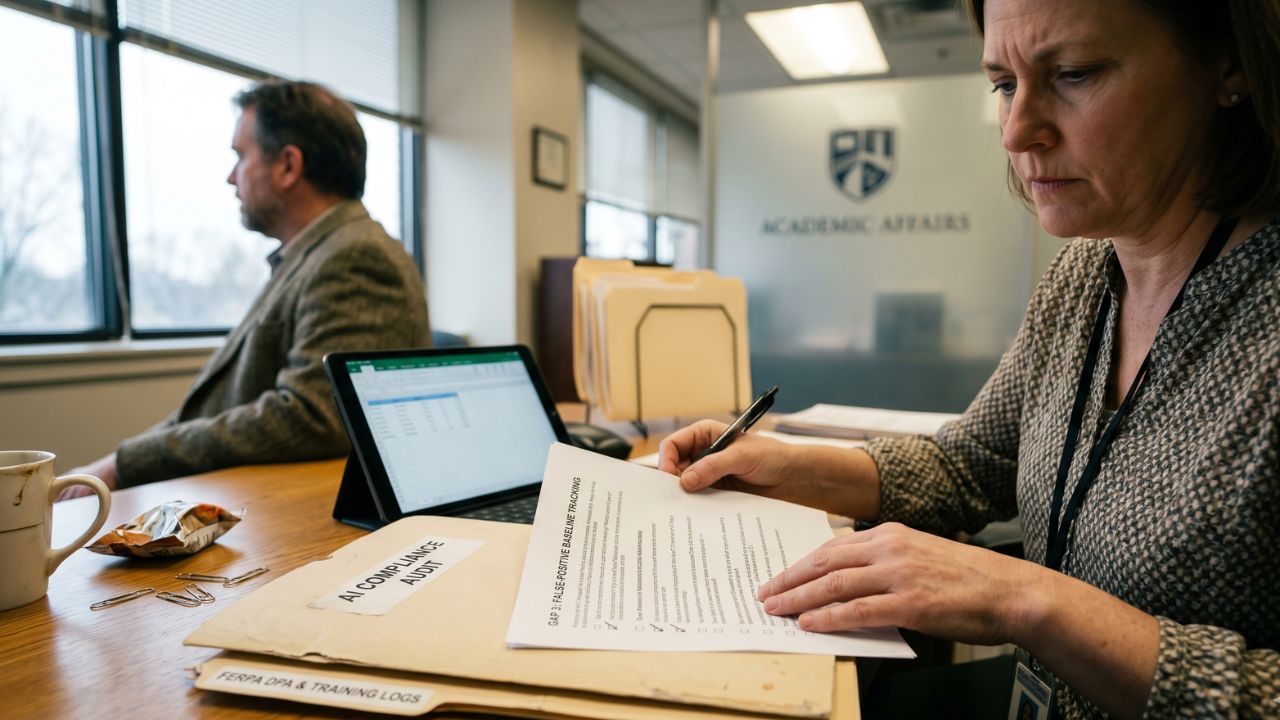
Every chatbot plagiarism checker produces false positives. ESL students, neurodivergent writers, and students who use Grammarly Premium are flagged at higher rates than others. Auditors expect institutions to know their false-positive rate. Moreover, they expect a plan for managing it. If you cannot produce a baseline false-positive rate from your last semester’s data, you have Gap 3. Start by running your AI plagiarism audit tool on a set of essays you know are human-written. Record how many get flagged. That number becomes your baseline. Then track it each semester.
Reducing Bias in Detection
Some tools perform worse on non-native English speakers. Therefore, test your chatbot plagiarism checker separately on ESL cohorts. If the false-positive rate is significantly higher, raise it with your vendor. Document this conversation. Auditors look for evidence that you actively manage bias — not just that you noticed it.
Gap 4: No Staff Training Records
Your chatbot plagiarism checker is only as reliable as the staff interpreting its output. Auditors ask to see training records for every faculty member and TA who uses the tool. Typically, institutions have no such records. Training should cover at minimum: how to read a detection score, what burstiness and perplexity metrics mean, and how to initiate a student appeal. Without formal training, a faculty member may act on a 55% AI score the same way they act on a 95% score. That inconsistency creates legal exposure in misconduct hearings. For more on detection thresholds and calibration, see our guide on the chatgpt essay checker and how to cut false positives by 63%.
Building a Training Log
A simple spreadsheet works. Record each staff member’s name, the training date, the format (live session, video, written guide), and a sign-off signature. Review this log once per semester. Auditors will accept this format without question.
Gap 5: No Appeal Workflow Documented
What happens when a student disputes a chatbot plagiarism checker result? Many institutions have no documented answer. The student files a complaint, the department scrambles, and the process becomes inconsistent. Auditors expect a written appeal workflow that is visible to students before they submit their work. The workflow should define who reviews the appeal, what evidence is considered, and how long the review takes. Moreover, it should explain what role the AI score plays — and what role it does not play. No student should face penalty based solely on an AI detection score.
Elements of a Defensible Appeal Process
- Student receives written notice of the AI flag within 48 hours
- Student may submit a written rebuttal with supporting evidence
- A faculty committee (not the flagging instructor alone) reviews the case
- Final decision is issued within 10 business days
- All outcomes are logged for at least three years
For a full breakdown of how to build evidence chains that survive appeals, see the AI essay detector framework that FERPA won’t tell you.
Gap 6: Audit Logs Are Incomplete or Absent
Your chatbot plagiarism checker must generate a complete audit log for every submission it scans. This log should capture: the submission ID, the detection score, the timestamp, the model version used, and the staff member who acted on the result. Under the EU AI Act Article 50 and emerging NIST AI Risk Management Framework guidance, high-stakes AI decisions require this level of traceability. However, many institutions rely on their vendor’s default export, which often omits the model version and the acting staff member. Consequently, the audit trail is incomplete the moment you need it most.
What a Compliant Log Entry Looks Like
| Field | Example |
| Submission ID | SUB-2026-04817 |
| Detection Score | 84% AI |
| Timestamp | 2026-04-12 09:31 UTC |
| Model Version | Detector v4.2.1 |
| Reviewed By | Prof. J. Okafor |
| Action Taken | Referred to integrity committee |
Build this log format into your process from day one. Retroactively reconstructing audit logs is both difficult and unconvincing to auditors.
Gap 7: Vendor Model Update Notifications Are Not Tracked
AI models change constantly. Your chatbot plagiarism checker vendor may update their detection model quarterly or even monthly. However, most institutions have no mechanism to track these updates. This creates a silent compliance gap. A model update might change your false-positive rate, alter detection thresholds, or introduce new sub-processors. Under a compliant essay AI control framework, you must be notified of material changes and you must document your review of those changes. Ask your vendor to add a contractual clause requiring written notice of any model update within 14 days of release.
Staying Current Without Constant Manual Checks
Set a calendar reminder for the first Monday of each month. Check your vendor’s changelog. Confirm no material updates have occurred. Log the check. This takes fewer than ten minutes and closes Gap 7 entirely. For a broader view of how tools compare across the full spectrum of AI detection, review our complete AI plagiarism checker comparison and audit framework.
The Benchmark Table Auditors Want to See
Auditors appreciate original data. Below is a sample benchmark format institutions can adapt for their own annual review.
| Control Area | Current Status | Last Reviewed | Owner |
| Model coverage policy | Documented | March 2026 | Dr. K. Sharma |
| FERPA DPA signed | Yes | Jan 2026 | Legal Office |
| False-positive baseline | 6.2% (spring 2026) | May 2026 | Dr. K. Sharma |
| Staff training records | 94% of faculty | April 2026 | Academic Affairs |
| Appeal workflow published | Yes | Feb 2026 | Student Affairs |
| Audit log completeness | 100% | Monthly | IT Compliance |
| Vendor update log | Current | May 2026 | Procurement |
Filling in this table annually — and keeping it on file — resolves all seven gaps in a single document.
Frequently Asked Questions
What 7 controls does an academic auditor check on a chatbot plagiarism checker?
Auditors look at model coverage policy, FERPA data-processing agreement, false-positive baseline, staff training records, student appeal workflow, audit log completeness, and vendor update tracking. Missing even one of these controls can trigger a full compliance finding during an institutional review.
How does a chatbot plagiarism checker differ from a traditional Turnitin scan?
A traditional Turnitin scan compares text against a database of known sources to find matching passages. A chatbot plagiarism checker uses statistical and linguistic models to identify patterns consistent with LLM-generated text. The two tools are complementary, not interchangeable. Most compliant workflows run both in sequence.
Can a chatbot plagiarism checker detect output from Claude, Gemini, and Copilot too?
It depends on the vendor. The best tools in 2026 cover multiple LLMs including ChatGPT, Claude, Gemini, Copilot, and open-source models like Llama. However, coverage varies widely. Always request a written model coverage statement from your vendor and verify it quarterly.
Does a chatbot plagiarism checker need a separate FERPA data-processing agreement?
Yes. Because a chatbot plagiarism checker processes student-submitted work on behalf of the institution, FERPA classifies the vendor as a “school official.” This requires a signed data-processing agreement that defines retention limits, sub-processors, and breach notification timelines before any student data flows through the tool.
How do I test a chatbot plagiarism checker against the latest LLM releases monthly?
Build a small test set of known AI-generated essays using the latest model versions. Run them through your detection tool each month. Record the detection rate and compare it against previous months. Flag any significant drops to your vendor immediately. This simple routine keeps your academic AI compliance gaps visible and manageable.
Conclusion
A chatbot plagiarism checker is a powerful tool. However, it only protects your institution when it is deployed correctly. The seven gaps above — missing model coverage policy, absent FERPA agreements, no false-positive baseline, untrained staff, no appeal process, incomplete audit logs, and ignored vendor updates — are the same gaps auditors find in nearly every review. Close them before the auditor arrives, not after. Document everything. Train your staff. Verify your vendor. This site, aicheckerdetector.com, provides purely informational guidance to help institutions and students understand AI detection tools. It does not constitute legal or compliance advice. For high-stakes decisions, always consult a qualified academic integrity professional and your institution’s legal counsel. Use these tools responsibly, and let evidence — not algorithm scores alone — guide your integrity decisions.
Excellent content! Sharing two great AI tools: Pixwit AI for creative image generation and Free Video Generator for video creation. Both free and powerful!